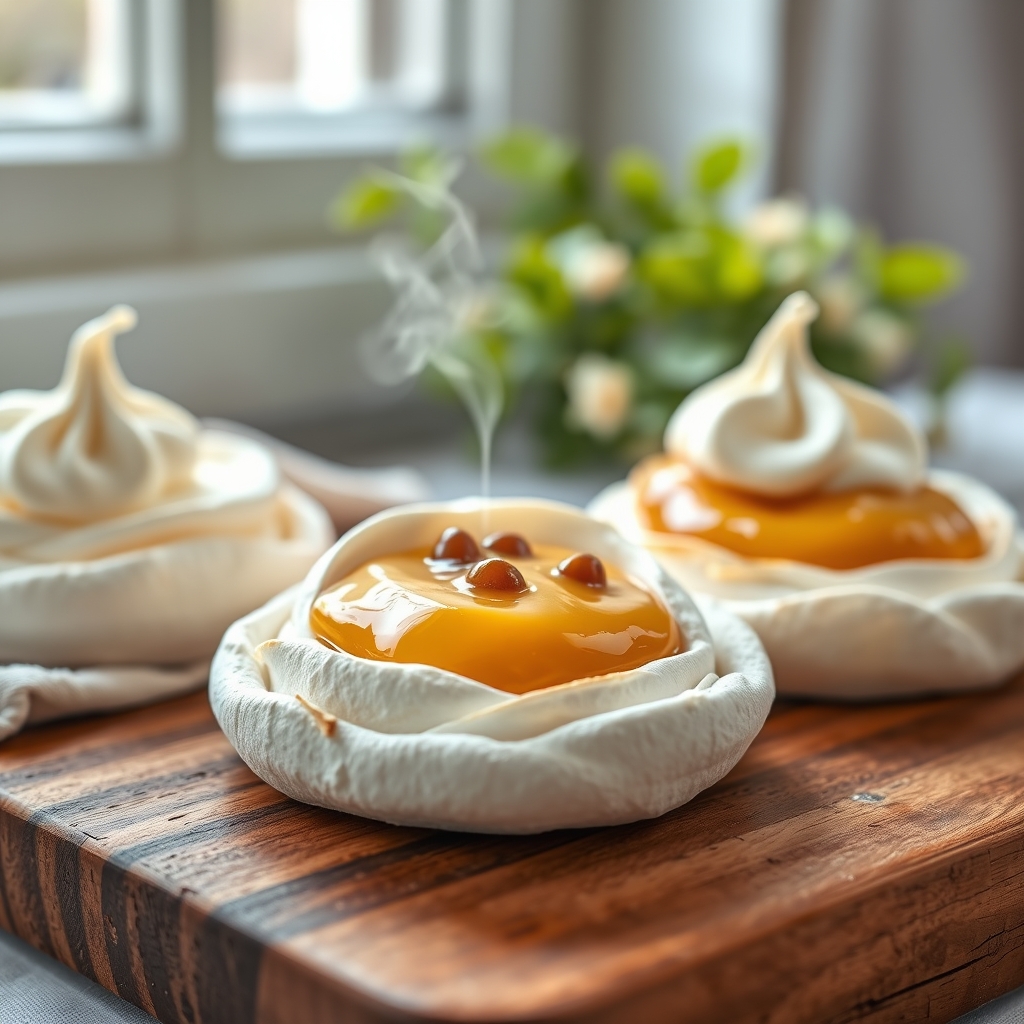

There are desserts that whisper, and then there are those that command the room. The Mini Pavlova Nests with Passionfruit Curd is the latter—a delicate meringue shell that shatters under the lightest touch, giving way to a marshmallow-soft heart, all crowned with a luscious, tropical curd that strikes the perfect balance between sweet and tart. I first encountered pavlova in a tiny café in Sydney, where the owner, a formidable woman with flour-dusted hands, declared it the national dessert. She was right. The name itself evokes the ethereal grace of the Russian ballerina Anna Pavlova, for whom it was created during her 1920s tour of Australia and New Zealand. Legend has it that a chef, inspired by her tutu, crafted a dessert as light and airy as her movements. This mini version—individual nests—takes the classic and makes it personal, an intimate dance of textures and flavors that feels both indulgent and effortless.
Why This Recipe Works
The magic of pavlova lies in the meringue’s structure. By whipping egg whites to stiff peaks and slowly incorporating superfine sugar, we create a stable foam that, when baked at a low temperature, dries into a crisp shell while the interior remains soft and marshmallow-like. The addition of cornstarch and vinegar (or lemon juice) is the key: cornstarch absorbs moisture, preventing weeping, while the acid strengthens the protein network. The result is a meringue that holds its shape, doesn’t crack, and has that signature chewy center. The curd, on the other hand, uses the technique of gentle double-boiler cooking to thicken without scrambling the eggs, yielding a silky, intensely fruity sauce that cuts through the sweetness of the meringue.
Ingredient Deep Dive
Egg Whites: The backbone of the pavlova. For best volume and stability, use room-temperature egg whites. Fresh eggs produce a tighter foam, but carton egg whites work too—just ensure they are at room temperature.
Superfine Sugar (Caster Sugar): Its fine crystals dissolve quickly into the egg whites, creating a smooth, glossy meringue. Granulated sugar can be used if pulsed in a food processor to make it finer.
Cornstarch: A stabilizer that prevents moisture from seeping out, keeping the pavlova crisp on the outside and soft inside.
White Vinegar or Lemon Juice: Acid helps strengthen the meringue structure, making it more resilient and less likely to crack.
Passionfruit Pulp: The star of the curd. Use fresh or frozen pulp; the seeds add a pleasant crunch and visual appeal.
Butter: Adds richness and a silky texture to the curd. Use unsalted so you control the salt level.
Egg Yolks: Thicken the curd naturally. The ratio of yolks to liquid ensures a luxurious consistency.
Heavy Cream: For the whipped cream topping, which provides a creamy counterpoint to the crisp meringue and tangy curd.
Masterclass Instructions
Step 1: Prepare the Meringue
Preheat your oven to 225°F (110°C). Line two baking sheets with parchment paper and trace six 3-inch circles (using a glass or cookie cutter) as a guide. In a clean, dry bowl of a stand mixer fitted with the whisk attachment, whip 4 large egg whites on medium speed until frothy. Increase speed to medium-high and gradually add 1 cup (200g) superfine sugar, about 1 tablespoon at a time. Continue whipping until the meringue is stiff, glossy, and holds a firm peak when you lift the whisk. This should take about 8-10 minutes. The mixture should feel completely smooth when rubbed between your fingers—no graininess.
Pro Tip: Ensure no yolk or grease touches the whites; even a speck of fat can prevent them from whipping properly.
Step 2: Add Cornstarch and Acid
Sift 2 teaspoons cornstarch over the meringue and add 1 teaspoon white vinegar or lemon juice. Gently fold with a rubber spatula until just combined—do not overmix or you’ll deflate the whites. Work quickly but carefully.
Step 3: Shape the Nests
Spoon the meringue onto the prepared circles, spreading it to fill each circle. Create a well in the center by swirling the meringue upward with the back of a spoon, building a rim. This will hold the curd and cream later. Smooth the sides for a neat appearance.
Step 4: Bake Low and Slow
Place the trays in the oven and bake for 60-75 minutes, until the meringues are dry to the touch and can be lifted off the parchment easily. The exterior should be pale and crisp; the interior should remain soft. Turn off the oven and leave the meringues inside with the door slightly ajar for another 30 minutes to cool gradually—this prevents cracking from sudden temperature change.
Pro Tip: Humidity is the enemy of meringue. Try to bake on a dry day, or run a dehumidifier if possible.
Step 5: Make the Passionfruit Curd
While the meringues cool, prepare the curd. In a heatproof bowl set over a pot of simmering water (make sure the bottom of the bowl doesn’t touch the water), whisk together 6 large egg yolks, 1/2 cup (100g) superfine sugar, and 1/2 cup (120ml) passionfruit pulp (about 4-5 passionfruits, sieved if you prefer seedless). Cook, whisking constantly, until the mixture thickens and coats the back of a spoon—about 10-12 minutes. The curd should reach 170°F (77°C). Remove from heat and stir in 3 tablespoons (42g) unsalted butter, cut into small pieces, until melted and smooth. Strain through a fine-mesh sieve into a bowl to remove any lumps or seeds (if you prefer). Cover with plastic wrap directly on the surface to prevent a skin from forming. Let cool to room temperature, then refrigerate until set, about 2 hours.
Step 6: Whip the Cream
Just before serving, whip 1 cup (240ml) heavy cream with 1 tablespoon powdered sugar and 1/2 teaspoon vanilla extract until soft peaks form. Do not overwhip—you want the cream to be billowy and cloud-like.
Step 7: Assemble the Nests
Spoon a dollop of whipped cream into the center of each meringue nest. Top with a generous spoonful of passionfruit curd. Garnish with fresh passionfruit seeds, edible flowers (like pansies or violets), or mint leaves for an elegant finish. Serve immediately.
Frequently Asked Questions
Q: Can I freeze the meringue nests?
A: Yes! Baked, unfilled meringues freeze well for up to 1 month. Place them in an airtight container with parchment between layers. Thaw at room temperature for 20 minutes before assembling. Do not freeze once filled.
Q: My meringue is weeping (beading with liquid) after baking. Why?
A: Weeping usually happens when sugar isn’t fully dissolved or when humidity is too high. Ensure your whites and bowl are completely clean, and bake on a dry day. Using cornstarch helps.
Q: Can I make the curd ahead?
A: Absolutely. The curd can be made up to 5 days ahead and stored in the refrigerator. Bring to room temperature before assembling.
Q: How do I fix a curd that is too thin or lumpy?
A: If the curd is thin, continue cooking gently while whisking; it should thicken as it reaches 170°F. For lumps, strain through a fine-mesh sieve. If it’s scrambled (cooked too fast), it’s unfortunately a lost cause—start over with gentle heat.
Q: Can I use other fruits for the curd?
A: Yes! Lemon, lime, or passionfruit work beautifully. Simply substitute the passionfruit pulp with your choice of citrus juice and zest.
Q: Why did my meringue crack?
A: Cracking can occur from sudden temperature changes. Always cool the meringues in the oven with the door ajar. Also, ensure your oven temperature is accurate—an oven thermometer helps.